


New paper: How delayed sound reveals the hidden system behind human speech

Updated: Jun 25
Have you ever been on a phone call where you suddenly hear your own voice echo back a split second later? It feels strange, confusing, and for many people it becomes impossible to keep speaking fluently. That tiny delay is enough to throw off the brain’s internal timing.
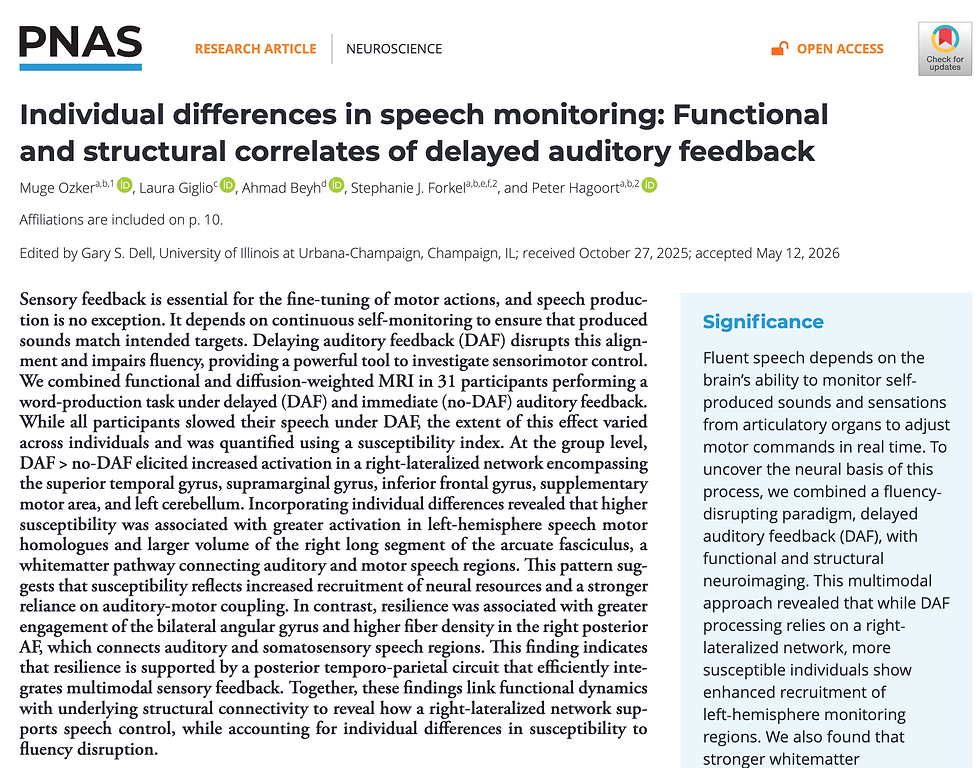
This concept is exactly what Müge Özker Sertel uses to uncover one of the most fascinating mysteries in neuroscience: how does the brain produce speech so smoothly? Her findings were recently featured in the PNAS journal.
The hidden teamwork behind every word you say
Speaking feels effortless, but it’s one of the most complex things a human body can do. More than a hundred muscles and many different organs work together to shape sounds into words. To keep everything running smoothly, the brain is constantly “listening” to itself. As Özker Sertel puts it, “speech is a motor action, just like reaching for a glass, your senses guide and fine-tune every movement.”
Two senses play a key role: hearing your own voice and feeling the movements and position of your speech organs. When these signals don’t match, the brain thinks something is wrong and tries to correct it. That correction mechanism is exactly what Özker Sertel set out to study.
Creating controlled confusion in the fMRI scanner
Inside an fMRI scanner, participants spoke simple three-syllable words while hearing their own voice through headphones. Sometimes the feedback was normal and sometimes delayed, occurring unpredictably across trials, so they couldn’t anticipate when it happened. The delay made many participants slow down, for some speaking became noticeably more difficult, while others were not really affected.
By combining voice recordings, fMRI, and structural brain imaging, the researchers could see not only how people reacted, but also which brain regions and networks were involved in responding to the delay.
The right hemisphere takes the lead
One of the most surprising findings was that the right hemisphere took the lead when speech was thrown off balance. “We saw much stronger activation in the right hemisphere when the feedback was delayed,” she explains. “It suggests that this side of the brain plays a dominant role in monitoring speech.”
But not everyone reacted the same way. Some people stayed fluent even when the delay was confusing. These resilient speakers tended to have stronger white-matter connections, the strong “communication cables” that link different brain areas, between the brain regions that process sound and those that process the position and movements of speech organs. It seems they can rely more on the “feeling” of their mouth when the sound becomes unreliable.
Why this matters for stuttering and Parkinson’s disease
This insight may help explain why delayed feedback, which disrupts speech in most people, actually improves fluency in people who stutter. It also connects conditions like Parkinson’s disease, where people often misjudge the loudness of their own voice, suggesting difficulties in monitoring speech. Understanding the healthy brain is the first step toward understanding what goes wrong.
Özker Sertel hopes that this line of research will eventually lead to better therapies, new brain-stimulation techniques, and a clearer picture of how speech works at every level.
Mapping to full speech network
She hopes that within ten years, researchers will have a complete map of all brain networks involved in producing fluent speech. “I would love to dissociate all the different systems that allow us to produce fluent speech and understand why humans are the only species that can do this smoothly.”
Every word we speak is a tiny miracle of coordination. By studying what happens when that system is pushed off balance, Müge and her colleagues bring us one step closer to understanding, and eventually improving, the way we communicate.
Literature reference
Muge Ozker, Laura Giglio, Ahmad Beyh, Stephanie J. Forkel, Peter Hagoort (2026). Individual Differences in Speech Monitoring: Functional and Structural Correlates of Delayed Auditory Feedback. www.pnas.org/doi/10.1073/pnas.2530123123


Comments